|
|
|||||
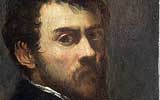
| Name by which the Italian name Jacopo Robusti (Venice 1518 - 1594) is known. Son of a modest dyer, Battista by name (and from his father's profession ( tintore = dyer) Tintoretto got his surname), according to what his biographer Ridolfi retells, in his youthful years he became one of Tiziano's apprentices, but he wasn't one for long because he allegedly aroused his teacher's envy by giving proof of exceptional ability and provoked this reaction with his fiery temper. Certainly, at least initially, from Tiziano he derived the sense of colour, although also Pitati and Schiamone must have contributed to the formation of his chromatic sensitivity, while his researches on the chiaroscuro and the movement of the Tuscan-Roman mannerism, that he was acquainted with through the works of Pordenone and Sansovino, must have offered him precious suggestions for the composition schemes, strengthening in him the animated and fantastic modes to which he was spontaneously addressed by his restless temperament. Finally he studied the nude technique in Michelangelo's work, to the extent that the critics' underlined Michelangelo's obvious influx in many of his works and that justified Ridolfi's account, according to which Tiziano assumed as an insignia for his own study the phrase, “ Michelangelo's drawing and Tiziano's colouring ”. These composite premises did not alter the painter's personality, but instead allowed its quick development; from these derive Jacopo's dynamic lighting, capable of creating at the same time light and motion effects, dramatic or magic suggestions and very bold perspectives and foreshortenings. Although the first works of his youth surely fall between 1540 and 1547 (two Mythological Scenes ; Last Supper in the church of S. Marcuola; etc.), his first painting of great effort is the Miracolo di S. Marco ( St. Mark's Miracle ; Venice, Accademia), of 1548. With a bold foreshortening, the Saint is depicted as he suddenly appears from above, invisible to the semi-circle of people that surround the naked slave an observe in amazement his broken chains; the warm tonal values are similar to Tiziano's, but the composition's ensemble, the plasticity of the shapes, that closely recall Michelangelo, and a certain narrative emphasis are already mannerist. After 1550 Tintoretto , by then the “trendy” painter of the time, was entrusted with a large number of commissions by privates, confraternities and by the Republic. S. Giorgio e il drago (St. George and the dragon ; London, National Gallery ) , goes back to 1553, this work reveals a closeness to Paolo Veronese in the wideness of the spaces and in the colour's luminosity, and that in the circular flashing of the rays asserts how light had progressively become the dominant element in the painter's style. The Storie Bibliche (Bible Stories) , painted for the Scuola della Trinità, belong to the time span between 1550 and 1553 approximately; in these an increasingly profound study of nude, faced with complex foreshortenings, can be observed, along with an intense quest for contrasting effects of light and shade. Standing by Ridolfi's affirmations, Tintoretto allegedly studied these lighting effects by resorting to the aid of artificial illumination; what's certain is that these, along with his style's evolution, will gradually intensify, until the human figure is by him reduced to plain light, colour and movement. A masterpiece that must be assigned to years 1555-15660 is Susanna e i vecchioni ( Susanna and the old-men ; Vienna), characterized by the intense luminosity of the feminine nude, by the notable rendering of the landscape details and by the perfect balance between both parts. The theme of St. Mark's miracles, already dealt with by the artist in 1548, was taken up again by him in three other paintings ( Rinvenimento del corpo di S. Marco - Finding of St. Mark's body ; Trafugamento del corpo di S. Marco – Stealing of St. Mark's body ; Miracolo del naufrago – Miracle of the outcast ) performed roughly between 1562 and 1568 by commission of the S. Marco's School. In these works the perspectives become deeper, broken in intervals by light and shade: it's the light that creates and undoes the bodies and that alternating with the shadow gives a dramatic tone to the composition, while the boldness of the foreshortenings become more spectacular. Specially in the Rinvenimento (the other canvases have suffered quite a number of alterations and restorations), the artist's anxiousness to multiply space deepening it by means of the arches' perspective flight, is evident; this is underlined by the portico's incandescent illumination; yet, non withstanding this variety of composition elements, the painting maintains unity and coherence, and does not degenerate into the theatrical and emphatic tone to which Tintoretto does not shun in other works, less accomplished, of those same years ( Adorazione del Vitello d'oro – Worship of the Golden Calf; Giudizio universale – Last Judgment ). Tintoretto attended to his maximum pictorial enterprise, that is to say, the decoration of Scuola di S. Rocco with 50 canvases inspired on the New and the Old Testament, in three different moments of his life: the paintings in the Albergo date back to 1564-66; those in the large upper Hall to 1576-1581; and those in the ground floor Hall to 1583-87. It has been said that Scuola San Rocco was for the Venetian maestro what the Sistine had been for Michelangelo, namely, the supreme proof of an absolute dominion of art, the admirable interpretation of a fantastic world that flashes in the imagination and causes feeling to be aroused. Surely only an intense spirituality and a feverish fantastic inspiration could give body to this great biblical poem that transfers on a sacred level the distresses and the anguishes of an epoch that was among the most tormented of Italian history. It's evident that in the immense cycle of the 50 canvases, inequalities, moments of tiredness and of expiration of the artistic intuition in the task, can be noticed; it's obvious as well that in a work whose execution lasted over twenty years there's bound to be an evolution in style, that's well verifiable when the canvases of the Sala dell'Albergo, in which the composition has a precise spatial definition and the colour has a noticeable richness of tonal values, are compared with those of the Upper Hall, characterized instead by the reduction of colourfulness to accentuated light and shade contrasts and by a more convulsed and dramatic movement. For instance, let's look at the gorgeous Cristo davanti a Pilato (Christ before Pilate) and the grandiose Crocefissione (Crucifixion) in the room of the Albergo. In the first painting the white, soaked of a veiled light, of the mantle that clothes the Christ, in contrast to the darkness in the backdrop, underlines the intense and pain-filled humanity of the Redeemer: the luminous mixture of the face's colour, the aureole formed out of simple bits of light, the softness of the body and the hands are equally effective psychological notations. In the huge Crocefissione the excited language of the composition, crowded by characters disposed in circle around the Cross but placed on different levels thus to create diverse and crossed perspective points, finds its unity in the light that links the various episodes and that immerses the whole scene in a fantastic and unreal atmosphere. A more intimate and calm tone, maybe due to the suggestion of analogous works by Bassano, can be noticed in the Natività of the large Hall; the light suddenly breaks in from above and illuminates the scene, divided in two superimposed floors according to the ancient medieval tradition, turning on glittering reflections on the members of the Sacred Family and on the Shepherds and highlighting humble details as well, like a rooster or a basket full of eggs. In the Ascensione , this too on the large Hall, light and movement merge breaking the perspective schemes in a triumphal vision that exalts the gigantic figure of the Christ held by a whirling flight of Angels, almost as a prelude to Greco's art; the Apostle's figures, placed in a lower level, are sort of dematerialised, reduced to simple luminous appearances. This lighting process of dematerialization of the bodies appears even more sensitive in the canvas of the ground floor Hall, carried out, as said before, in 1583-87. We find the proof of it in the Adorazione dei Magi , in which the figures of the procession are nothing but a mixture of light and colour, bundles of brush strokes that emphasize movement ignoring the concreteness of matter. Or, let's look at the two paintings with Maria Egiziaca (Egyptian Mary) and Maria Maddalena (Mary Magdalene) , analogous on account on the vertical composition scheme and for the sense of remote solitude and meditation that emanates from their romantic nocturne landscapes immersed in a warm reddish tonality. In both canvases the light penetrates sideways investing the Maria Egiziaca oh her back and Maria Maddalena on her face, laying down with light touches on the waters and the frayed foliage of exotic trees in the first painting, wetting, in the second one, with more extended stains a tree's bare trunk with more dramatic light and shade effects. In these two works there's a looseness of rapid execution, almost by motions, highly effective in revealing things, that expresses the mystic, spiritual and psychological values implicit in both subjects that the artist has felt with profound and sincere religiosity. While attending to S. Rocco's canvases, Tintoretto was performing many other works: the four civil allegories with Arianna, Bacco e Venere, Pallade che scaccia Marte, le Tre Grazie con Mercurio, La Fucina di Vulcano , finished in 1577 for the Duke's Palace, the tondo with Giunone che consegna a Venezia il pavone and the other allegories frescoes in the ceiling of the Sala alle Quattro Porte between 1578 and 1581, the immense Paradiso for the Sala del Maggior Consiglio, the largest painting in the world, crowded by a myriad of characters that circle around Jesus and the Virgin in the Empyrean, and dozens of other paintings. The last most important effort of the painter were the two canvases for S. Giorgio Maggiore's Choir with La caduta della manna and the Ultima Cena , of 1594, the first one is somewhat unusual because of the episodic character and the serene rustic tone of the landscape maybe inspired by Bassano's humble intimate art; the second one instead is entirely fantastic and recreated from the flashes of an abstract light, diagonally cut by a very audacious perspective. In his long career Tintoretto had also painted numerous portraits, warm with colour tones, with the accustomed light flashes and typical fantastic imagination. Among the most beautiful of these there's Jacopo Soranzo's (Milan), carried out in the full vigour of his maturity; Pietro Aretino's portrait is quite interesting also as a document for our literature's history, with him Tintoretto was in terms of cordial friendship and they held a correspondence that is precious to date some of Tintoretto 's canvases. The meaning of the work of this maestro must be linked with the spiritual crisis that after the Reformation oppressed the souls living in the late Renaissance. The Olympic gratification found by the spirit in beauty, the full trust in men's capacity as creator of universal values was by then setting to give way to restlessness, to withdrawal into one's self and to the quest for new inner and religious values more suitable to the altered spirituality. Tintoretto felt this drama as well, that would debouch into the baroque sensitivity. His tendency to steal from reality's corporeity by means of a fantastic and essential lighting, his insistence on the tortuous game of broken lines, of light and shade respond to the demand of expressing a tormented inner self rummaging deeply in it, even as the aulic classicism of the early sixteenth century had voiced men's trust in its dominion over the world. His very same restless temper pushed him to find new ways to express himself, different to the Venetian tone-based art and from the mannerist plastic style, and none of these means was more suitable to him than the flashing light with which he built his canvases, a light completely different form the natural one, capable of recreating the inner reality of things, entirely free from outer appearances, such as the artist perceived it deep inside his soul. From a constraint of enlarging and deepening the spaces, almost out of a thirst for the infinite, bold perspectives are birthed (for instance, let's consider the Last Supper in S. Rocco's School or the Lavanda dei piedi , Prado), the plane-crossing, the spectacular foreshortenings, that theatrical tone that to some critics appears as the negative element in Tintoretto 's art. Yet, this tormented and sincerely religious spirit, that was able of expressing itself now with the dramatic tragic imprint of his Crucifixions, now with the melancholic idyll of his Fuga in Egitto (Venice, S. Rocco), also found accents of burning sensuality in the definition of feminine nude in a series of pictures of biblical subjects ( Giuseppe e la moglie di Putifarre – Joseph and Potiphar's wife ; Prado), mythological ( Venere e Vulcano ; Monaco) or allegorical ( Concerto ; Dresda). So varied and complex are the components of his personality: from the scenographic emphasis of the Presa di Zara ( Zara's Take ; Venice, Palazzo Ducale), to Maria Egiziaca 's withdrawn and thoughtful intimacy, to the intense dramatic approach of the Pietà (Brera) to the almost idyllic purity of Adamo ed Eva (Accademia), all of these, diverse and even contrasting attitudes but all equally rescued by a sincere participation in the theme and by a prodigious mastering of the pictorial means. Such a vast work, that embraces hundreds of works, could not have been accomplished without the help of pupils that often were collaborators; and the maestro had several of these - Antonio Vasilacchi known as l'Aliense; Andrea Vicentino; his sons Domenico , also known as Tintoretto (Venice 1560 - 1635), Marco (born maybe around 1561) and his daughter Marietta known as Tintoretta (born maybe around 1556) – but all of them mediocre: the only one to have drawn from his youthful art was the greatest maestro of European mannerism, namely il Greco. Also because of this ideal pupil, but not only because of this, the personality of the Venetian maestro appears to us as one of the greatest protagonists of modern European painting. |
||||||
---------------------------------- |
||||||
|
||||||