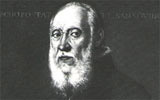
Italian painter and sculptor Jacopo Tatti (Florence 1486 - Venice 1570) is known by this name, the same one given to his teacher Andrea Contucci. When he was fifteen years old he became Andrea Sansovino's apprentice, but beyond his examples and teachings, he was formed in contact with the Florentine artistic environment of the time, and afterwards with Rome's, where he stayed from 1506 al 1511, busy drawing ancient monuments and at the same time beginning his activity as a sculptor. Returning to his town, he sculpted S. Giacomo e un Bacco (Bargello), a balanced and well-performed work that, due to the predominance of the pictorial values above the more strictly plastic ones, remains one of the most sincere witnesses of the artist's personality. Defeated by Michelangelo in the contest for S. Lorenzo's façade, Jacopo left Florence heading for Rome (1518), where he sculpted S. Giacomo (S. Maria di Monserrato), the Madonna del Parto (S. Agostino) and other works, trying, not always successfully, to measure up to the grandiosely classical forms drawn from Michelangelo's example. In Rome his activity as an architect had its beginning; indeed in that city he planned the churches of S. Marcello and S. Giovanni dei Fiorentini (iter 9) (built or completed by others), palazzo Nicolini-Arici (at the time called Gaddi) in the Suburb of Santo Spirito and the palazzo for Giuliano de' Medici (now called Palazzo Lante); and this activity, in which Sansovino interlaced his own work to that of the maestros followers of Bramante's foot-steps at work in Rome at the time, such as Peruzzi e Raffaello, must be the starting point to understand the further evolution of his architectonic style. This became fully uncovered after Sansovino , to flee form Rome's sacking (1527), moved to Venice. From the atmosphere of the lagoon city and from its tradition based on colour, Sansovino drew nourishment to overcome Bramante's serene and intervallic spatial setting of his Roman edifices and to develop architecturally those pictorial currents that, partly, had already appeared in his sculptural production. As a matter of fact, in Venice he was able to happily insert on the lagoon environment the classicism of the sixteenth century Tuscan-Roman shapes through the light and shade game of objects and moulding, the pictorial spirit of the bas-reliefs and the ornaments, the predominance of void over fullness, the airiness of the galleries. His activity in Venice was very intense: he completed the Old Procuratie, he begun the Zecca building, he constructed the Scuola Grande della Misericordia (unfortunately not complete), S. Marco's small gallery (that he decorated with statues and reliefs, placing inside the splendid terracotta group of the Madonna col Bambino e San Giovannino ), he worked in the new factories in Rialto, in the churches of S. Francesco della Vegna and di S. Giuliano, as S. Marco's Overseer he reinforced the Basilica's structure, projected the Golden Staircase in Palazzo Ducale and built Villa Garzoni in Ponte Casale. However his Venetian masterpieces are Corner (1532) and the Libreria (1537), in which there's a complete evolution from a plastic architectonic vision, although animated by light, to a purely lighting vision that subordinates mass to the effects of light and chiaroscuro. A similar dematerialization process can be noticed in his last sculptural work, that is, in the bronze door of S. Marco's Sacristy with the Resurrezione e la Deposizione (Resurrection and Deposition) (fused in 1562-63), in which echoes of Donatello and Ghiberti can be retraced. Tommaso Rangone's portrait in S. Giuliano's façade, S. Giovanni Battista ai Frari, and other works belong to his latter production. Friends with Tiziano and Aretino, Sansovino had a preponderant function in Venice's artistic environment; among the sculptors Vittoria, Gerolamo Campagna and others were followers of him; among the architects, Scamozzi and later, Longhena, looked up to his works.