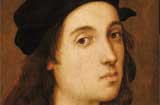
Raffaello Sanzio (Urbino, April 5, 1483 – Rome, April 6, 1520).
His father, Giovanni Santi, a painter which followed Melozzo da Forlì's tradition, died when Rafaello was only eleven years old; his following teacher was Timoteo della Vite, a painter returned to his native Urbino from Bologna and Perugia. But the position of the very young student must never have been that of real dependence, so much that as early as in 1500, when the painting with the Incoronazione di S. Niccolò da Tolentino (now destroyed) was commissioned to him, Raffaello was already ascribed with the title of “maestro”, notwithstanding his very young age. Up to ten years ago three small paintings ( So gno del Cavaliere , London; Madonna del Libro , Leningrad; Tre grazie , Chantilly), were considered to be the first gems of Raffaello 's juvenile art; these were placed next to the diptych depicting St. George and St. Michael in Louvre. Today, there's a propensity to move the painting of this group of works to a date around 1505, recognizing in them a definitive detachment from Perugino's modes, fluidly large modeling, ample breath in the composition and poetic sensitivity in the union between figures and landscape. After the very first works of his adolescence (banner with the Madonna della Misericordia and the Crocefissione , Città di Castello; fresco depicting the Madonna col Bambino , Urbino; Resurrezione , S. Paolo del Brasile), Raffaello 's prodigious precocity is proved by three works that are, the third one particularly, among the maestro's greatest; Incoronazione della Vergine , in the Pinacoteca Vaticana ( iter 9 ), dated 1503, the contemporary Cr ocefissione Mond (London) and Sposalizio della Vergine (Brera), of 1504. In the Incoronazione della Vergine ( Virgin's Crowning ), the composition scheme, the movement of the figures, the faces and the draping match Perugino's, yet already in it, as well as in the Crocefissione , it's possible to notice the adoption of vaster planes divisions, that release the modeling from the insistent chiaroscuro to the very bright spatial arrangement of the Sposalizio della Vergine ( Virgin's Marriage ), only apparently inspired to Vannucci's frescoes, but the same shiny and clear brightness of the chromatic texture, so vivid in Raffaello , reveals just how much his art surpasses that of the Umbrian painter. Only Piero della Francesca, if anyone at all, could have suggested to Raffaello , the sense of a spatial composition so rich of breath, such a Renaissance-like capacity to compose in harmonious agreement the monumental nobility of the immense temple in the back with the profound spirituality of the figures in the foreground by means of the perspective flight of the large square's slabs. With this work Raffaello 's capacity to interpret the Renaissance's ideals of a classic harmony is already fully enacted, and it's not surprising how by then he felt ready to maturate his sensitivity by coming in contact with richer experiences than those that could be offered by the provinces of Umbria and Marche, where he had lived until then. He traveled to Florence once in the autumn of 1504, but he settled there definitely only at the beginning of 1506, to remain there until 1508. The Florentine ambient was at the time dominated by Leonardo and Michelangelo's sovereign personalities, that precisely in the autumn of 1504 were working on the sketches for the Battaglia di Anghiari and the Battaglia di Cascina : Leonardo should have taught him to make use of the shade technique to grasp the living beings in their organic essence and to feel them as living things, around which air circulates; from Michelangelo he allegedly took hold of his constructive and expressive strength and the dramatic capacity of movement, new ways to revive the ancient. Raffaello was able to receive with measure and discretion the Florentine elements in his style subordinating them to the same ideal of beauty which had inspired him during his period of likeness to Perugino's art. In all of the works of the Florentine period, it's perceivable how Raffaello alternately approached these painters, receiving Leonardo's shading or Michelangelo's “plasticism” or fra' Bartolommeo's constructive shapes; but these assimilations remain circumscribed to the field of technique, all of them dominated by a prodigious ability to discipline the impressions that could have been overwhelming for other less gifted personalities. Let us observe the Deposizione (1504-1507, oil on canvas, cm. 180 x 186; in Rome, Galleria Borghese ( iter 7 ): the classical reminiscences, that also draw from Michelangelo, are clear; but the eurhythmic, balanced composition, in it measure, if it demonstrates the maestro's scarce inclination for dramatic subjects, it also testifies to an intellectual lucidity that allows him to unify two different themes, the Seppellimento di Cristo ( Christ's Burial ) and the Svenimento di Maria ( Mary's fainting ), separately elaborated. Or let us observe how slow, progressive and intelligent it's the approach to the Florentine examples in another group of works, such as the Colonna altarpiece (New York), the Ansidei altarpiece (London) and the Northbrook Madonna (London). A wonderful synthesis of Leonardo's modes, perceptible mostly in the composition's vertical structure and in the shadows that lap the modeling, is certainly perceivable in the portrait of an unknown lady known as the Muta ( Mute – Urbino) and in the Madonna del Granduca (Florence, Pitti); among the examples of pyramidal composition, closer to fra' Bartolomeo, there are the Madonna del Belvedere (Vienna, Kunsthist Museum), the Madonna del Cardellino (Uffizi), the Bella giardiniera (Louvre), and other works, not to mention a numerous group of drawings. Raffaello Sanzio always conserves a faithfulness to himself, whether he exalts the Virgin's majesty not by resorting to the traditional elevation on a throne, but motivating it with the very perfection of the features; or whether he places her tender and pensive humanity in a pleasant and luminous landscape. Even when, in the uncompleted Madonna del Baldacchino (Florence, Pitti), the group of the Virgin with the Baby is lifted to the height of an imposing throne, the grandiosity of the Bramante- styled apse that concludes the scene and the acute individuation of every one of the Saints that surround the throne reflect a search for monumentality that marks the immediate presupposition of Raffaello 's work following his move to Rome (1511). Nor can we disregard other masterpieces performed in Florence in those years, such as the Madonna degli Orléans (Chantilly), the S. Caterina (London), the Madonna Esterháy (Budapest), the Madonna Canigiani (Monaco), the portraits of the Doni consorts (Pitti) and the Gravida (Pitti). This very portrait of an opulent Florentine bourgeois, depicted with considerable signs of an advanced maternity, well testifies of how Raffaello 's art was always turned to ennoble any subject; that the painting's cutting derives from Leonardo's Gioconda , becomes a secondary fact with regard to the dignified and human character, plainly honest to the point of assuming a popular tone, that the artist is able to impress on this image; and all it takes is the gesture of the left hand gently laying on the lap to underline that indefinable sacred something that a woman's maternity ever carries with it. Raffaello arrived to Rome in 1508 , summoned there by Giulio II, who entrusted him with the task of frescoing the new apartment which the pope had selected for himself in the Vatican. The apartment was comprised out of three halls. In 1511, Raffaello completed the decoration of the first room (known as Stanza della Segnatura , which means Signing Room , because the pontifical briefs were signed in it) depicting on the four walls the Disputa del Sacramento ( Dispute of the Sacrament ), Parnaso , the Scuola di Atene ( Athens' School ) and Tre Virtù ( Three Virtues ); in the ceiling he represented the allegories of Theology, respecting some parts begun by Sodoma and by Bramantino: Filosofia, Astronomia , Giustizia e Poesia ( Philosophy, Astronomy, Justice and Poetry ). With this enterprise the cultural patrimony of humanity was enriched by one of its highest monuments, and not only on account of the nobleness of the doctrinal concept concealed on the vault's allegories and confirmed by the four parietal scenes, but mostly because of the supreme pictorial quality of the Disputa and of the Scuola di Atene . The room is indeed a triumphal celebration of the three basic ideas of the human spirit, according to neo-platonic doctrine: of that which is True, acted out with the twofold concourse of Faith ( Dispute of the Sacrament ) and Science ( School of Athens ); of Good, achieved through the exercise of Justice ( Justice, Cardinal and Theological Virtues ); and of Beauty, realized by poetic creation ( Parnaso ). Even more prominent, as it has been said, is the quality of the frescoes: the majestic polyphony of the Disputa , specially with the choir of Apostles surrounding the Trinity in the heavens above and the militating church, on Earth, that worship God in the miracle of Eucharist, for the cadenced rigor that determines its space, the heroic intensity of the concept and the lyric distribution of the light, it places itself among the utmost witnesses of artistic genius of all times. The School of Athens is perhaps only a little inferior, there where the learned and the philosophers of ancient times are called to witness to the validity of classical thinking, given that it had made an effort to attain that which is true by means of the exercise of philosophy and of science. The background of the composition are the majestic vaults of a temple, shaped in the likes of Bramante's greatness of dimension; in the center, against the luminous backdrop of the sky, the figures of Plato and Aristotle stand erected, imposingly positioned, the first one with his finger pointed upwards to recall the world of ideas, the second with the hand stretched out forward to admonish on the earthly problematic of human moral. All around them, the other teachers of the ancient world are positioned with free variety ( Diogenes, Euclid, Heraclites, Epicure, Pythagoras, Tolomeo ), and next to these some among the greatest contemporary personalities ( Bramante, Michelangelo, Leonardo, Bembo, and Raffaello himself), with a very keen interpretation of that myth of renewal that is at the very foundation of the Renaissance thinking. After painting the Galatea in the hall of the Farnesina (iter 5) , between 1512 and 1514 Raffaello attended to the decoration of the second Room, Eliodoro's room, that aims to extol with allusive biblical and historical references ( Cacciata di Eliodoro; Messa di Bolsena; Liberazione di S. Pietro; L'incontro di Leone Magno con Attila ) Giulio II's mission, deliverer of the church with divine assistance. Stylistically, it represents the rapid evolution of Raffaello 's art to the sixteenth century taste: to the static, solemn and balanced Signing Room, follow, in this second Room, compositions that in their intensity of movement and light contrast even seem to prelude to the Baroque. It's likely that it was Sebastiano del Piombo's example to enrich Raffaello 's art with a new chromatic liveliness: let's notice how the architectonical decoration is more allusive and cruised by light and shadows, let's observe the counterpoint of three different lights that make of the Liberazione di S.Pietro ( St. Peter's liberation ) such an evocative painting; let's admire how, in the Miracolo di Bolsena ( Miracle of Bolsena ) linens turn white, purple cloths blaze and the fresh color of the feminine vests contrasts with the shrill uniforms of the Swiss: it will become clear that a further enrichment for Raffaello 's art had been represented by the knowledge of the Venetians' chromatic technique through the Roman activity of Sebastiano del Piombo and of Lotto. The fourth story was almost entirely painted by aids, it depicts the Incontro tra Leone Magno ed Attila ( Encounter of Leon the Great and Attila ), in which the composition's clarity and unity appear undone by the excessive number of characters and by their turgid modeling, perhaps due to, besides of a renewed influence from Michelangelo, to the intense collaboration of aids. To him, then, we owe the painting of the third Room, known as that of the Incendio di Borgo ( Fire in the Suburb –1514-17 ), in which only the composition that gives the room it name bears direct traces of the maestro's intervention. The Sala di Costantino ( Constantine's Hall ) was also decorated by his pupils, according to Raffaello 's drawings, after their teacher's death (1520). The last phase of Raffaello's activity was overburdened by evermore numerous and frequent commissions; but before we come to that it's necessary to briefly recall the main paintings performed by him in parallel to the first Rooms. We've already briefly mentioned the Galatea (1511), the first mythological subject treated by the maestro after the Tre Grazie in Chantilly; about this painting, the fresco in the Farnesina (iter 5) has an extraordinary vital charge that is expressed through the strong modeling and the quick movements that originate from Michelangelo. The Madonna di Foligno (1511-1512; Rome, Pinacoteca Vaticana, iter 9) is linked instead to the chromatic innovations of Eliodoro's Room , this was Sanzio's first altarpiece painted on sixteenth century schemes, well accomplished concerning the landscape and atmospheric aspect, probably deriving from Dosso Dossi's influence. Also in the contemporary portraits ( La donna velata , Pitti; Baldassarre Castiglione , Louvre) we have the revelation of a colorist Raffaello ; specially in Castiglione's portrayal the supreme balance of the figure in relation to the backdrop is achieved precisely through the subtle luminous variations of the grays and the mellow and light sweetness of the pictorial matters, that relate with a deepening of the modeling, psychologically interpreted according to the moral and aesthetic canons of the Renaissance. Meanwhile Raffaello frescoed the Isaia in the church of S. Agostino (iter 6) , drawing inspiration from Michelangelo's Profeti in the Sistine Chapel, the Sibille of S. Maria della Pace (iter 6) , the Madonna della Seggiola (Pitti), so perfect because of the attentive calculation of the gestures and the intense vitality of the characters, Visione di Ezechiello (Pitti) and Giulio II (Uffizi). During the pontificate of Leone X, Raffaello 's activity continued tirelessly. Even more, his work as a painter was also complemented by architectural assignments. Assigned to take Bramante's place in the direction in St. Peter's building (iter 9), he had the thought of opposing a Latin cross project to Bramante's conception of a Greek cross; some buildings were raised on projects designed by him, such as the church of S. Eligio degli Orefici (via S. Eligio), the Roman palazzi Caffarelli and Branconio d'Aquila, Palazzo Pandolfini in Florence, all works that, although linked back to Laurana and Bramante's experience, testify to an architectural vision suggested by the maestro's harmonic and pictorial treatment, thereby ensuring a place for him alone in the history of Italian sixteenth century architecture. In the meantime he prepared the sketches for the ten tapestry pieces with the Storie Evangeliche (1515-16), he painted, albeit resorting to aids, Santa Cecilia (Bologna), he decorated the Loggia di Psiche of the Farnesina (1517) , he headed his pupils work, in the grotesque decoration in the Logge Vaticane, completed in 1519. Yet he also left a large group of paintings entirely autographical, that witness of the prolific enrichment of his style and the supreme masterfulness attained by his art in these years, that would be the last of his life. We will only indicate, as examples of this extreme phase of his activity, the Madonna Sistina (Dresda), so coherent in the disposition of the figures projected against a tearing in the sky made visible by the opening of both screens of a curtain, the portraits of Cardinale (Prado), Fornarina (Roma, Gall. Nazionale d'arte antica Palazzo Barberini, iter 3) and that of Leone X , so extraordinary because of the intense agreement of the reds, so intense in the sharp interpretation of the pope's psychology and of cardinals Giulio de' Medici and Ludovico de' Rossi. And finally, the Transfigurazione (Rome, Pinacoteca Vaticana, iter 9) ; this was surely one of the Raffaello 's last pictorial works, painted by him only in the upper part, while the lower part was carried out by Giulio Romano after his teacher's death. The painting, incomplete, was solemnly displayed at the head of Raffaello 's coffin, before which all of Rome reverently and mournfully paraded, previous to its burial in the Pantheon (iter 6) , to pay homage to the artist that better than any other had known how to moderate classicism and Christianity, the artist in which his contemporaries observed the most comprehensive synthesis of the Renaissance's figurative culture. And that also, while still alive, had been criticized but more out of animosity than out of conviction, as it always happens with the great souls, and non only within the artistic environment, to the degree that when the frescoes with the fable of Amore e Psiche were discovered, Lionardo Sellaio hastily write to Michelangelo that they were “ chosa vituperosa ” (“ a vile thing ”). And exalted and sourly criticized Raffaello would also be by the posterity; extolled when his artistically perfect composition was passed on to the Baroque's historiography with Bellori, and to the neoclassical theory with Mengs or when the classicizing current of painting, from Domenichino to Reni, to Poussin and Ingres, emulated his figurative ideals. Criticized from the nineteenth century onwards, and in harsher measure in recent times, when he was condescendingly defined a brilliant eclectic, an assimilative person full of exceptional capacity for re-elaboration. All of these judgments that would appear as tied to transitory tastes, and that don't lessen the greatness of his genius, so much does it still appear today substantiated by an exalting beauty-generating strength. |