| NAME |
YEAR |
PLACE |
ITER |
| Pietà |
1498-1499 |
Basilica di San Pietro in Vaticano |
9 |
| Affresco della volta della cappella Sistina |
1508-1512 |
Vaticano |
9 |
| Cristo risorto (forse con la collaborazione di Raffaele da Montelupo) |
1514-1521 |
S.Maria della Minerva |
6 |
| Giudizio universale (su incarico di Clemente VII, confermato nel 1535 da Paolo III ) |
1533-1541 |
Vaticano |
9 |
| Sistemazione della statua equestre di Marco Aurelio al Campidoglio |
1538 |
Piazza del Campidoglio |
1 |
| Affresco della crocifissione di S.Pietro e Conversione di S. Paolo |
1542 |
Vaticano |
9 |
| Sistemazione della piazza del Campidoglio, e cordonata di accesso dal lato settentrionale (completati da Giacomo Della Porta e altri) |
1544-1552 |
Piazza del Campidoglio |
1 |
| Direzione della fabbrica di San Pietro, dopo la morte di A. da Sangallo il giovane |
1546 |
Basilica di San Pietro in Vaticano |
9 |
| Mosè . Giulio II gli aveva affidato nel 1505 la scultura della propria tomba. La “tragedia della sepoltura” (così la chiamava M. durò per 39 anni e, dopo molti contratti, terminò con questa sola statua |
1505 1544 |
S.Pietro in Vincoli |
4 |
| direzione dei lavori del Palazzo Farnese, successe ad Antonio da Sangallo il Giovane |
1546 |
Piazza Farnese |
5 |
| Termine degli affreschi della Cappella Paolina |
1550 |
Vaticano |
9 |
| Disegno della scala del cortile di Belvedere |
1552 |
Vaticano |
9 |
| Incarico per la costruzione della Cupola di San Pietro (costruita dopo la sua morte da G. Della Porta e da D. Fontana) |
1555 |
Basilica di San Pietro in Vaticano |
9 |
| Modello per la Cupola di San Pietro |
1557 |
|
- |
| Progetto per la Chiesa di S.Giovanni dei Fiorentini |
1559 |
Via degli Acciaioli, 2 |
9 |
| Disegni per la Cappella Sforza in S.Maria Maggiore |
- |
S.Maria Maggiore |
3 |
| Prospetto della Porta Pia verso la città |
1560 |
- |
- |
| Progetto per la Chiesa di S.Maria degli Angeli (poi modificata dal Vanvitelli) |
1561 |
Piazza dei Cinquecento |
3 |
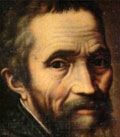
Italian sculptor, painter, architect and poet (Caprese, March 6, 1475 – Rome, February 18, 1564). At the age of thirteen he already attends Domenico Ghirlandaio's office, the following year he moves to the sculpting school directed by Bertoldo in the Medici gardens. The very young artist is formed drawing Giotto's and Masaccio's paintings, whose plastic essence and grandiosity were congenial to his spirit. He was noticed by Lorenzo de' Medici, who took him into his household as a son. From 1490 to 1494 he remained with the Medici, where he got to know Poliziano, Marsilio Ficino, Pico della MIrandola and all of the greatest humanists of that time. Of this period's activity some works remain, the reliefs of the Madonna della Scala (around 1491) and of the Battaglia dei Centauri (around 1492), both of these are now kept in Casa Buonarotti in Florence; in these works the artist's personality already proves to be mature and original, both in the adoption of the flattening technique, employed on the Madonna with plastic and volumetric effects well different from Donatello's pictorial intentions, as in the vigor and contrast of forces that give such solidity to the second relief. In October of 1494 Michelangelo, foreseeing Piero de' Medici's ousting, left Florence heading for Venice and afterwards Bologna, and in this city he raised the two small statues of S. Petronio and S. Procolo and an Angel to hold a candelabrum for S. Domenico's arch in the church by that same name. During his sojourn in Bologna the study of Jacopo della Quercia's sculpture and of Ferrara's great painters must have influenced the artist's maturation process. With the return to Florence and the following journey (1496) to Rome by invitation of cardinal Riario, the first phase of the maestro's activity comes to and end. The Roman works ( Bacco , 1496, Florence, Museo Nazionale; Pietà , 1498, Rome, St. Peter in the Vatican – iter 9 ) reveal a new attitude; in the Bacco , a careful meditation on classical art and an indrawn and thoughtful serenity in the Pietà , that in its high spiritual religiosity formally concludes the experiences of the Florentine fifteenth century plastic and begins that of the sixteenth century. The first great creative phase of his youth coincided with the following stay in Florence (1501-1505). Cardinal Francesco Piccolomini commissioned of him 15 statues for an altar in Siena's dome (Michelangelo performed with the assistance of aids only those of the saints Peter, Paul, Pius and Gregory). The Arte della Lana commissioned of him the David, rapidly finished and placed (1504) in the staircase in front of Palazzo della Signoria (it was afterwards replaced by a copy, the original instead is in Galleria dell'Accademia), the gigantic statue of David is a wonderful masterpiece of physical energy united to the high moral value of its gaze. That certain struggle between spirit and matter, that will turn out to be one of Michelangelo 's main expressive characteristics, already appears. A severe serenity emanates from the group, shortly latter, of the Madonna col Bimbo that, purchased by Flemish merchants, is now found in the church of Notre Dame in Bruges. In 1504 the Council commissioned Leonardo with the task of frescoing the Counsel Hall of Palazzo Vecchio with the Battaglia di Anghiari ; shortly after Soderini ordered from Michelangelo a fresco with an analogous topic to decorate the wall facing the one assigned to Leonardo. Michelangelo then prepared the cartoon for the Battaglia di Cascina (1506) quickly divided in pieces by the craftsman that were copying it. Three tondi date back to those same years, two in marble depicting the Madonna , the Child and S. Giovannino while the third, portraying the Sacred Family (Florence, Uffizi), painted for Agnolo Doni, is Michelangelo 's only autographed painting on a board. Of the two marble tondi, the first one (London, Accademy), sculpted for Taddeo Taddei, recalls Leonardo in the Child 's springing movement and in the research for an atmosphere that vibrates with light, in the second one( tondo Pitti , Florence, Bargello), instead, completed volumes detach themselves from the backdrop with a plastic effect and the long and heavy shapes are alike to those of the David . Analogous effects, though as a painter, were achieved by the artist in the tondo Doni , with cold and sharp coloring, while the spiral shaped grouping of the bodies, specially those of the Virgin and the Child, offer a first sample of that quest for “pyramidal, twisted and multiplied” human figure, as described by Lomazzo, that will be one of the most frequent themes in Michelangelo 's art. Summoned to Rome (1505) by pope Giulio II, he received from him the assignment to build the mausoleum that would be positioned within the apse of St. Peter's basilica, which was under construction. Thus began what Michelangelo would later call “the tragedy of sepulture”, a truly obsessive idea that was destined to occupy the artist's mind for forty years (form 1505 to 1545), that in the end was fulfilled in the most varied shapes all of them much less grandiose than those conceived in 1505. The project he presented that year did in fact conceive a mausoleum in the shape of a grandiose aedicule covered with statues, inside of which, with a re-elaboration in a Christian sense of the ancient mausoleums, 40 figures larger than real life characters should have expressed man's struggle to conquer peace in faith. The marbles for the tomb ha already been chosen by the artist during a few months stay in Carrara's caves; but once he returned to Rome, Michelangelo found Giulio II already engaged in other enterprises and determined to have him paint the Sistine's vault; outraged, the artist left Rome (1506), heading for Florence, where he continued working on the cartoon for the Battaglia di Cascina ; then (November 1506) he appeared before Giulio II in Bologna, who by that time had conquered that city, and having received his pardon, he was assigned with the task of portraying the pope in a bronze statue that was to be placed on S. Petronio's façade. The statue was completed in the beginning of 1508, but in May 1511 it was destroyed by the people of Bologna, who had risen up against the pontifical dominion. In the meanwhile the artist, summoned back to Rome, had to submit himself to Giulio II's will and prepare to paint the Sistine's vault. This immense work, begun the tenth day of May 1508, was half done in September 1510, and completely finished in October 1512. The theme of the frescoes is the history of the world and of humanity before Christ, which perhaps should be interpreted as the drama of the shift from matter to spirit and from sin to Grace. The narrative cycle unfolds in the direction that goes from the altar to the Chapel's entrance, that is, in the direction opposite to the one in which the artist actually painted the frescoes. Nine panels, alternatively larger and narrower, illustrate in several episodes the creation of the world, the original sin, the Flood; naked figures (Angels or Geniuses) flank the panels and are linked to the thrones' frames, upon which, in the vault's triangles, sit the Prophets and the Sibyls, pre-announcers of the coming of the Redeemer; instead, in the vault's lunettes and in the lunettes themselves Christ's antecessors are portrayed; finally further scenes are depicted in the four angular pendentives, these allude to the help offered by God to the people of Israel. No other work of his enthralls in such an irresistible way on account of the originality of its setting, of the overwhelming and dramatic richness of its themes, of a powerful and assured elevation over the empiric world. Its structure is that of a great “animated architecture”; in it, as Vasari wrote, Michelangelo “in the partition did not make use of severing perspectives, nor a steady view, but he adjusts more the partition to the figures, than the figures to the partition.” At the beginning of 1513 Giulio II died: consequently Michelangelo had to stipulate a new contract with the pope's heirs for the late pope's tomb, preparing therefore a second project, more modest than the first one, and starting to work on it immediately. Of the statues for the tomb the artist completed (1513-14) two Prigioni (“ Prisioners” – Prigione morente and Prigione ribelle , now in the Louvre) and sketched (1520-22) four others (Florence, Accademia). Perhaps the group known as Vittoria (Florence, Palazzo Vecchio, around 1532) was also destined to Giulio II's tomb. The only one among the statues sculpted for that complex that eventually became part of the tomb erected in 1545 in S. Pietro in Vincoli in Rome (iter 4), is the Mosè (1513-16) . These are years of unremitting and multiform activity, however embittered by contrasts, by projects that remained unfinished or that where completed only later, by personal and public disappointments and misadventures: in 1514 the Cristo Risorto (Rome, S. Maria sopra Minerva – iter 6) is sculpted, a work of great classic serenity, although weakened by damages and by the interventions of collaborators. Between 1516 and 1520, by will of Leone X, drawings and a model are prepared for the façade of S. Lorenzo in Florence, according to a project that was destined to fail due to the pope's changing his mind; in 1524 Leone X orders the maestro to raise the S. Lorenzo's New Sacristy destined as a sepulcher for the Medici family, a work that the new pope, Clemente VII, also a Medici, allowed him to continue until its completion (1534), while at the same time he had Michelangelo build the Biblioteca Laurenziana in Florence, begun in 1524. To these labors Michelangelo was committed until 1527, alternating stays in Rome and in Florence; here he took refuge due to the imminence of Rome's sack (1527), and still here after the ousting of the Medici from the city, he adhered out of personal conviction to the new republican government, agreeing to direct Florence's fortifications, menaced by the armies of the pope and of the emperor. But suspecting the imminent betrayal of Malatesta Baglioni, Captain of the republican troops and having uselessly warned the Florentine authorities of this, he suddenly fled to Ferrara and then to Venice (October 1529), from whence he planned to make his way to France. Declared a rebel by the Republic, and afterwards pardoned, he returned to his homeland during the siege and he fought bravely; after the city's fall (1530) at first he was forced to hide from view, but Clemente VII pardoned him ordering him to continue the works for the Biblioteca Laurenziana and for the Cappella Medicea in S. Lorenzo. As it was carried out, the chapel does not entirely match Michelangelo 's original project; he had, in fact, planned to decorate the walls with frescoes and stucco-work and furthermore he intended to raise the tombs of Lorenzo il Magnifico and of his brother Giuliano besides of other sculptures, of which the models of the Dio fluviale ( River god - Florence, Accademia) and the Giovane Accasciato ( Discouraged Young man - Leningrad) remain. At the same time, also by order of Clemente VII, Michelangelo worked on the Tribuna delle Reliquie in S. Lorenzo and in the Biblioteca Laurenziana. In 1534 the artist left Florence definitely and settled in Rome, where, once Clemente VII died, the new pope, Paolo II, appointed him as the Vatican's palace architect, painter and sculptor (1535) and gave him the assignment of frescoing with the Last Judgment the Sistine's wall placed over the altar (iter 9) . On December 25 of the year 1541, the work was uncovered, arousing great admiration, but also provoking the criticism of the more bigot exponents of the new Counterreformation tendencies, who reproved the maestro for depicting the characters of the immense fresco in nudity. Those critics, as known, where sadly regarded, and many parts of the nudes in the composition where later veiled by work of Daniele da Volterra. No other work expresses better Michelangelo 's profound religious torment when he returned to the Sistine to complete on the altar's wall the youthful cycle painted on the vault; the ideals of his youth, that aroused a heroic humanity outstretched in the awaiting of the Messiah, by then appeared distant, elapsed, almost sinful. As much as he had been impressed, even from his youth, by Savonarola's preaching, a deep psychological transformation had taken place within him only in the last years, which was reaffirmed by his relationship with the catholic reformist group linked to Vittoria Colonna, the kind poetess who, from 1538 until her death (1547) was a true friend to him. As Dante's Divine Commedy, the Last Judgment is a grandiose vision of humanity subject to the swirling forces of the universe, a terrible image of an entire religious system that finds its dramatic center in the grave, imperious gesture of Christ the Judge, in which Michelangelo contemplates his own, personal condemnation. It's indeed known how the maestro, with infinite painful humility, portrayed himself in St. Bartholomew's skin. In the meanwhile Michelangelo had sculpted (around 1539) for Donato Giannotti Brutus' bust (Florence, Bargello), a masterpiece of modest dimensions. Michelangelo 's last pictorial enterprise dates back to 1542, that is, the two frescoes with the Conversione di S. Paolo (St. Paul's Conversion) and the Crocefissione di S. Pietro (St. Peter's Crucifixion) in the Cappella PAolina in the Vatican ; in these, some characters (the placement of figures portrayed only partly, the “bird-flight” prospective conception, etc.) prelude to aspects that will afterwards be peculiar elements of the latter mannerism, but the color's variety and selection and the sad gentleness of the landscapes reveal superb pictorial qualities. But it was his activity as an architect that absorbed in these years almost all of the artist's energy: when Antonio da Sangallo the Young died (1546), Michelangelo took his place in the direction of the works in Palazzo Farnese (iter 5) and in the position as St. Peter's architect , exactly at the same time when he received the assignment to plan a new arrangement for piazza del Campidoglio (iter 1) . At the moment of Michelangelo's death the construction of the new buildings designed by the artist was far from being finished, therefore Giacomo della Porta, and the others that continued his work, could modify the original plan. However the square was conceived by Michelangelo as an almost completely contained environment, to which one enters by means of a vast ramp, the “cordonata”, that links it to the city underneath; the two lateral palaces (Palazzo dei Conservatori e dei Musei) are obliquely aligned in relation to the piazza's main axis, this accentuates the reduced ampleness of the ambiance; on the fourth side rises Palazzo Senatorio, surmounted by a tower and preceded by a staircase, that, due to its greater height and the identical shape vigorously contrasts with the lateral palaces, in which a profound courtyard creates dense shadowy areas. So, the whole marvelous urbanistic complex seems to be inspired by the same restrained “plasticism” and by the same “antithesis” that presides Michelangelo 's sculpture: yet it is admirably unitary, centered as it is around the equestrian monument to Marco Aurelio, for which Michelangelo designed a new oval shaped plinth , so that it would be in agreement with the paving's star-shaped decoration, which was encircled by an ellipsis (iter 1) . A few other works belong to these last years, among others: Porta Pia's prospect facing the city (1560) , S. Maria degli Angeli's re-arrangement (iter 3) , later re-elaborated and modified by Vanvitelli, and the beautiful projects for the church of S. Giovanni dei Fiorentini (iter 9) , which were made by order of Cosimo I but not carried out; yet the most important work of all, by far, that worried the artist until his death, was the completion of St. Peter's Basilica (iter 9) . For this building, Michelangelo resumed Bramante's concept of the central plant, but simplified Bramante's complex planimetry replacing its “clear, orderly and luminous” balance with a powerful concentration of masses which drew a certain rhythm from the vertical elements of the gigantic order. To achieve these effects, Michelangelo , having reinforced the structures of the walls that had already been built, animated the building's masses with a strong shadows play obtained by means of the opening of niches and closed windows with a solid trabeation concluded on the top by the mighty tambour of the cupola . The cupola was afterwards built by G. della Porta and D. Fontana, who modified the model applied by Michelangelo giving greater energy to the ensemble and less volume to the ribbing. However, had the cupola been built shaped as a semi-spherical bowl, according to Michelangelo's original project, it would have even better suggested the sense of massive restrained plasticity offered by the complex as a whole. Although committing almost entirely to architecture and not receiving any further commissions for sculpting jobs, in these last years Michelangelo didn't neglect the art he preferred; only, he practiced it for himself, as an outlet of his profound religiosity, to express with it his “gratitude to Christ Who, with His example had revealed to him the path of peace and salvation, repeatedly depicting Him in the act of sacrifice” (Russoli). Three is the number of the Pietà that he sculpted in his last fifteen years: the one that is now in Florence's Accademia, known as that of Palestrina, because it was kept in the town by that name in Palazzo Barberini, not everyone however deem it to be an autographed work; these doubts on regard of its authenticity are perhaps justified only by possible subsequent modifications, since Christ's pathetic figure well compares to that of the Prigioni in Florence albeit in its greater solemnity which draws it nearer to the figures of the Cappella Paolina. A “sacrificed harmony of painful tenderness” (Russoli) is instead expressed in the very beautiful Pietà (1547-1555) kept in Florence's Dome, a group in a pyramidal shape with interlacing counter-positioned elements, perhaps conceived by Michelangelo for the tomb he would have wanted to be built for him in S. Maria Maggiore. Michelangelo 's last, unconcluded, work is the Pietà Rondanini (Milan, Museo del Castello), so called after the Roman palace by that same name from whence it comes. Three drawings, kept in Oxford, allow us to follow the evolution of the artist's thought in the execution of this, his extreme masterpiece. Michelangelo, by then very ill, continued to work on the Pietà Rondanini until the very last days of his life, shut inside of his house in Macel de' Corvi on February 18 1564 he passed “from a horrible storm into sweet calm”. Buried in Rome, initially, in the church of the SS. Apostoli, his body was afterwards moved to Florence to rest in S. Croce. There are many drawings left by him, which are now gathered in Casa Buonarroti in Florence and in very many Italian and European collections. Michelangelo was also a writer and a poet, his writings and Rime (Rhymes), on account of the vigorous adherence to the platonic concepts of beauty that distinguishes them from those of the writers of the time, Petrarca's followers, can give more that one suggestion for a righteous interpretation of his art, that influenced almost all of the artists of his time, even the greatest of these, such as Raffaello, Tiziano, particularly, Tintoretto; later Rubens and many others, even the Romantics Gericault and Delacroix, felt his influence. Quite worthy of notice was the contribution of his art to the development of mannerism, specially in Florence and in Rome, but indirectly, also elsewhere, in painting and in sculpture. Analogously, also in the evolution of the Italian architectonical shapes and in part, in the foreign ones, Michelangelo's conceptions and modes had more or less echo during all of the second half of the sixteenth century and the first years of the seventeenth century.
|