| NAME |
YEARS |
PLACE |
ITER |
Erminia trova Tancredi ferito |
1618-1619 |
Galleria Doria Pamphilj |
1 e 7 |
Et in Arcadia Ego |
1618-1622 |
Galleria Nazionale di Arte Antica Palazzo Barberini |
3 |
Affreschi dell' Aurora, il Giorno, la Notte, Giochi degli amorini, la Fama, scherzi d'acqua e dame che si bagnano |
1621-1623 |
Villa Ludovisi |
3 |
Sepoltura di Santa Petronilla (pala destinata alla Basilica Vaticana) |
1621 |
Pinacoteca Capitolina |
1 |
S. Maria Maddalena genuflessa e piangente |
1622-1623 |
Pinacoteca Vaticana |
9 |
La morte di Didone |
1631 |
Galleria di Palazzo Spada - Piazza Capo di Ferro, 13 |
5 |
Allegoria della pittura e della scultura |
1637 |
Galleria Nazionale di Arte Antica Palazzo Barberini |
3 |
La flagellazione di Cristo |
1657 |
Galleria Nazionale di Arte Antica Palazzo Barberini |
3 |
Saul attacca Davide |
1646 |
Galleria Nazionale di Arte Antica Palazzo Barberini |
3 |
La Sibilla Persica |
1647 |
Pinacoteca Capitolina |
1 |
Sacra Famiglia |
- |
Pinacoteca Capitolina |
1 |
Cleopatra davanti a Ottaviano |
- |
Pinacoteca Capitolina |
1 |
San Giovanni Battista |
- |
Pinacoteca Capitolina |
1 |
San Matteo e l'angelo |
- |
Pinacoteca Capitolina |
1 |
S. Agostino lava i piedi al Redentore |
- |
Chiesa di S. Agostino |
6 |
S. Agostino, S. Giovanni Battista e S Paolo l'eremita |
- |
Chiesa di S. Agostino |
6 |
S. Agostino |
- |
Chiesa di S. Pietro in Vincoli |
4 |
S. Margherita |
- |
Chiesa di S. Pietro in Vincoli |
4 |
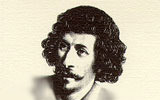
Italian painter (Cento 1591 – Bologna 1666). His artistic formation took place in the orbit of the Carracci's school, although the real teachers were the local mediocre painters. His first meaningful work, the Madonna in Gloria fra Santi (Virgin in glory among saints) , performed in 1616 for the large church of S. Agostino in Cento (now in Brussels' museum), already reveals his peculiar pictorial chiaroscuro and the grandiosity of the composition. He paints with strong lighting contrasts and for this he has been related to Caravaggio, but, even if the starting point is the same, the result differs. With the chiaroscuro technique Caravaggio models with great plastic force, outlining with precise and clean lines, in Guercino 's art shadows acquire an airy transparency and do not neatly oppose themselves to the light, that does not concentrate in any point, but spreads itself all over the composition. Around 1618 Guercino made a trip to Venice to present a book of drawings made by him, entitled First elements to introduce young people to drawing , with which he introduces himself as an art theoretician. The stay in Venice and getting to know the works of the greatest painters such as Tintoretto, Tiziano, Bassano, will be important for Guercino 's following production. To this period belong the S. Guglielmo di Acquitania and the Martirio di S. Pietro of the Pinacoteca di Bologna, the Susanna al bagno of Galleria del Prado, and the Susanna e i Vecchioni of Galleria Pitti: works of intense an precious colour. In 1621 he was summoned to Rome by Alessandro Ludovisi, already his protector in Bologna, who had become pope Gregorio XV, and he stayed in Rome until 1623. The most important work of his roman sojourn, that is certainly his masterpiece, is the fresco with the Aurora on the vault of Villa Ludovisi's country house (iter 3). Framed by Tassi's illusionistic architectures the depiction is set with foreshortenings to cause it to assume a dynamic value, underlined by the shadow play of the cloudy sky, in tune with the white and black spots of the horses' mantle. Guercino in this work performs a painting of very modern effect with the staining technique; in one of the lower compartments the Notte (Night) is depicted, a romantic feminine figure that will serve as a model for so much of the baroque art. In a room next to that Aurora, Guercino painted a landscape with water games and ladies bathing , with great liveliness and spontaneity, anticipating some of the later-to-be Roman and French landscape painters which were at work in Rome around 1630, among which was Poussin himself. And in another hall of the Ludovisi country house, he depicted the Fama (Fame) , that stands out in the centre of the ceiling within a cornice of illusory architectures that simulate a portico. The huge painting with the Seppellimento di S. Petronilla (St. Petronilla's burial) of the Capitoline Museum in Rome belongs to the same period, this work is notable because of the strength of the chiaroscuro, the splendid colour derived by the Bolognan school, and the realism of the grave-diggers that recall Caravaggio's in the Seppellimento di S. Lucia . Guercino 's brief stay in Rome did not allow for the painter to be influenced by the artists that worked in the City at that time, nor for him to influence others at the same time. In 1623, after the death of Gregorio XV, Guercino left Rome to spend the rest of his life in Emilia between Cento, Reggio, Piacenza and Bologna. In Piacenza he continued the frescoes in the Dome's vault, already begun by Morazzone, with animated figures of Prophets : this is the last work in which Guercino unfolds the lighting freshness of his youthful manner. From 1642 forward he settled definitely in Bologna as successor and heir of his great rival Guido Reni, but the fresh inventive of his fantasy was lost in the quest to adapt to the demands of the triumphal classicist aesthetic, therefore his works, although not lacking merit, remain by much beneath the level of the former ones. Of this period we remember the following works: Cristo che appare alla Maddalena (Christ appearing to Magdalene) (Cento), the Decollazione di S. Maurelio (St. Maurelio's beheading) (Ferrara), the Semiramide of Dreda and the Ripudio di Agar (Agar's repudiation) (Brera), all of them alike, lifeless and unoriginal. Guercino was also an engraver and left numerous drawings, marked by his light and nervous touch, that are among the seventeenth century cleverest.
|