| NAME |
YEAR |
PLACE |
ITER |
| Erma di Passamonti – gesso |
1780-1781 |
Tavolini |
- |
| Monumento funerario di Clemente XIV –marmo |
1783-1787 |
Basilica dei Santi Apostoli |
- |
| Monumento funerario di Clemente XIII -marmo |
1783-1792 |
Basilica San Pietro |
9 |
| Testa di Clemente XIII – gesso |
1784-1786 |
Accademia di San Luca |
- |
| La famiglia Vitali – olio |
1790-1798 |
Museo di Roma |
- |
| Perseo trionfante – marmo |
1797-1801 |
Musei Vaticani |
9 |
| Creugante – marmo |
1795-1801 |
Musei Vaticani |
9 |
| Damosseno – marmo |
1795-1806 |
Musei Vaticani |
9 |
| Ercole e Lica |
1795-1815 |
Galleria Nazionale d'Arte moderna |
7 |
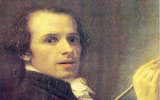
| Autoritratto – olio |
1798-1899 |
Museo di Roma |
- |
| Teseo lotta con il Minotauro – terracotta |
1800 circa |
Tavolini |
- |
| Venere vincitrice - Paolina Bonaparte - marmo |
1801-1808 |
Galleria Borghese |
7 |
| Ritratto di Paolina Bonaparte – marmo |
1809 |
Galleria Borghese |
7 |
| Ritratto in gesso di Napoleone |
1802 |
Accademia di San Luca |
- |
| Ritratto di Pio VIII – marmo |
1806-1807 |
Protomoteca Capitolina |
1 |
| Stele funeraria di Giovanni Volpato - marmo |
1804-1807 |
Basilica Santi Apostoli |
- |
| Stele funeraria conte A.De Souza Holstein –marmo |
1805-1808 |
Chiesa S.Antonio dei portoghesi |
- |
| Monumento funerario di Vittorio Alfieri – gesso |
1804-1805 |
Galleria Nazionale d'Arte moderna |
7 |
| Leopoldina Esterhàzy Liechtesterin –terracotta |
1806-1807 |
Museo di Roma |
- |
| Ritratto di Domenico Cimarosa – marmo |
1808 circa |
Protomoteca Capitolina |
1 |
| Danzatrice con dito al mento – marmo |
1809-1814 |
Galleria Naz.d'arte antica |
- |
| Autoritratto – gesso |
1811-1812 |
Museo di Roma |
- |
| La Religione Cattolica – gesso |
1813-1814 |
Pontificio Seminario Romano Maggiore |
- |
| La Religione Cattolica – gesso |
1814-1815 |
Accademia di San Luca |
- |
| Busto d'ignoto |
> 1814 |
Tadolini |
- |
| Cenotafio degli Stuart – marmo |
1817-1819 |
Basilica di San Pietro |
9 |
| Gorge Washington – marmo |
1817 |
Museo di Roma |
- |
| Pio VI orante – marmo |
1817-1822 |
Basilica di San Pietro |
9 |
| Pio VI orante – gesso |
1817 |
Pontificio Seminario Romano Maggiore |
- |
| Ritratto di Pio VII – marmo |
1820-1822 |
Musei Vaticani (Chiaramonti) |
9 |
| Compianto di Cristo . gesso |
1820 circa |
Pontificio Seminario Romano Maggiore |
- |
| Busto di Maria Vergine – marmo |
1821 |
Marchese Patrizi |
- |
| - |
- |
- |
- |
| CONOVA'S SCHOOL |
- |
- |
- |
| Erma di benedetto Marcello - marmo |
1725-1825 |
Protomoteca Capitolina |
1 |
| Ritratto di Pio VI |
- |
Villa Braschi |
Tivoli |
From his grandfather, master builder and chiseller, he learned the first elements of the job, but his true teachers were G. Bernardi-Torretti and G. Ferrari in Venice, where he was able to study thanks to senator Falier's interest who had intuited his gifting. The works of the Venetian period ( Orfeo ed Euridice, 1773; Apollo ; clay portraits of doge Paolo Renier and of don Gian Matteo Amadei; Dedalo e Icaro ) still resent of the eighteenth century taste, but already in the last of these a certain realistic accent perceived in the anatomic exactitude of Dedalo 's figure serves to confer a greater plastic determination to the shapes and underlines the refined taste for the picturesque, almost Hellenic, of Icaro 's image. He travelled to Rome with architect G. A. Selva in 1779, he settled definitely in that city in 1781; and here he came in contact with the classical precepts upheld by Winckelmann and zealously observed by his admirers. It's therefore natural that ever since the first of his Roman works ( Teseo , 1781; monument to Clemente XIV in the church dei SS. Apostoli ) the first signs of the neoclassical ideals can be adverted, well visible, for instance, in the renunciation to the employment of polychrome marbles for the pope's tomb, that however is, in its composition schemes, mindful of Bernini's pompous tombs. This was the first of a numerous series of funeral monuments erected by Canova ; from the one to Clemente XIII (1791) in S. Pietro in Vaticano guarded by an emphatic religious statue that is yet psychologically very sharp in the representation of the praying pope, to the latter tombs of a Maria Cristina of Austria (1798-1804) in Vienna and of Vittorio Alfieri (1810) in Florence, both built according to the scheme of the pyramidal mausoleums, all the way down to the Stuart sepulchre (1819) in St. Peter in Rome flawless in the harmony of the lines and made unforgettable by the images of the two splendid Angels with overturned torches, of a tender yet carnal sweetness. But even more than in the sacred themes, too often interpreted more with formal programmatic rigorousness than with vigilant artist's emotion, Canova 's genius was expressed in the series of sculptures of mythological subject that he began composing starting from the last years of the eighteenth century: thus several groups are born, Amore e Psiche in the Louvre (1793), a clever interlacing of youthful shapes modelled with gorgeous refining, the very elegant Ebe in the two-fold version in Berlin and in Forlì (around 1800), so devoid of every erudition albeit in its conscious recalling of classical models; the monumental Ercole e Lica (1815) sampled on Hellenistic schemes and not exempt of skilfulness in the highly studied search for balance in the composition between both figures. In 1798 he had gone far from Rome to avoid that year's Revolution; he returned there in 1799, but shortly afterwards, by then having risen to Europe-wide fame, he started working for Napoleon, who called him to Paris in 1802 and in 1810. In these years, besides those quoted earlier, a number or works were performed: Paolina Borghese's portrait (1808, Rome, Galleria Borghese ), depicted in the resemblance of Venus Victor, Napoleon's bust (Possagno) and nude statue (1809; Milan, Brera), Maria Luisa's bust, the gorgeous Venere Italica in Galleria Pitti, the Perseo and the two Pugilatori of the Vatican Museums, etc. Napoleon's statue in Brera maybe one of the best-known among the innumerable hero-celebrating portraits performed by Canova in his fortunate career; if it leaves us cold by now on owing to its evident drawing from the tradition of Hellenistic portraits, the harmonious image of the Paolina and the Venere (Pitti) suggest a subtle admiration for the happy attainment of pure ideal of beauty that has found in the artist an immediate and sincere response. In 1815 Canova returned to Paris to claim the restitution of the art treasures taken by the French, from there he went to London where he had the opportunity to know Phidia's art admiring the Parthenon's friezes which Lord Elgin had transported from Athens to England in those very same years. So the last phase of Canova 's activity was initiated, to this belong the Tre Grazie in Leningrad, the monument to Pio VI in the Confessione Vaticana , the Endimione dormiente in Possagno, Pio VII 's bust , etc. Canova 's art has exercised an enormous influence on the early nineteenth century sculpture, and it is surely possible to discover in him the only true great sculptor of the European neo classicism; however the results achieved by him are not always constant: when he was finally able to free himself from the excessive rules to let out his inexhaustible creative richness, then Canova produced works rich of a trepid poetry that are to this day still alive owing to the gesture's composure, the harmonious elegance of the shapes and the modelling sensitivity. But when the neoclassical theories and the celebrative and official demands suffocated his more truthful evocative vein, Canova 's sculpture rightly appears as cold and academic. Perhaps this is why the critics' attention has been attracted to the numerous clay and terracotta models that are kept in Possagno's Gipsoteca; and, really, these are very fresh creations, free from every stylistic convention; however, it must not be forgotten that for the maestro those models were only summary starting-points destined to be afterwards realized in flourishing images of ideal and impassive beauty; to forcefully want to attribute a different value to these, does not seem appropriate nor legitimate. The rare paintings, among which the Autoritratto (Florence), add nothing to Canova 's art.