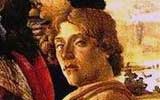
BOTTICELLI , Sandro Alessandro di Mariano Filipepi
Pupil, according to Vasari, of Filippo Lippi, in his first dated work ( La Fortezza, 1470) he reveals the remembrance of the soft shapes of the maestro next to the pleasure of modeling which was dear to Pollaiolo and the firm and closed plasticity distinctive of Verrocchio. These initial suggestions were rapidly merged by Botticelli in a highly original pictorial language while bit by bit the influence of the platonic culture absorbed in the court of Lorenzo il Magnifico, a dear acquaintance became deeper in him; already in the works of his youth ( Ritorno di Giuditta e Ritrovamento del cadavere di Oloferne in the Uffizi; S. Sebastiano in Berlin; Giuliano dei Medici's portrait, Bergamo; Adorazione dei Magi in Florence, ecc.) Pollaiolo's linear tension softens in a gentler, more harmonic way of shaping the characters, seconded by a precious chromatic range, now vivid, now softer and almost colorless. The central period of Botticelli 's art is comprised out of the time span between the Primavera (around 1477-78) and the Nascita di Venere (1483-84), from a humanistic point of view outstretched towards the yearning of an ideal beauty, to which the memories of classical mythology offer the figurative themes and the harmonious line play and color's transparency give an inimitable musical grace; in both masterpieces, images of a diaphanous, immaterial beauty barely suffused by a vague melancholy, seem to graze the marine or wild landscape, without making any binding contact with it whatsoever; maybe in no other work, nor figurative nor poetic, the Florentine fifteen century classicism has ever found a more complete and high expression. There's less effectiveness in the three frescoes inspired on biblical themes ( Purificazione del lebbroso; Mosè e le figlie di Jetro; Distruzione di Core ) carried out by Botticelli in 1481-82 on the walls of the Sistine Chapel in the Vatican; although they don't lack effective details and vigorous male portraits, at times the composition appears too crowded and the determination of the contours excessively nervous. Some of Botticelli 's most significant works belong to the period between 1480-90: the Madonna del Magnificat (Uffizi), the Pallade vincitrice del Centauro (Uffizi), the Madonna e S. Barnaba (Uffizi), Venere e Marte (London), all inspired to the speculative effort, typical of the Florentine philosophers of that time, of reconciling through the platonic doctrines the classical naturalism and the Christian spiritualism; among these the tondo with the Madonna del Magnificat dominates on account of the absolute perfection of expressive means, in which the very same circular shape of the painting determines the musical rhythm of the composition, perfectly concluded yet light and airy. In the meanwhile, the burning preaching of monk Gerolamo Savonarola, Magnifico's death, the revolution and the fall of the Medici deeply modified, between 1490 and 1494, Florence's life, and a religious crisis roused in Botticelli 's soul by the Savonarola's very preaching, are generally assumed as reasons to explain the stylistic characters of the works of the last period ( Pietà of Monaco and of Milan; Allegoria della Calunnia in the Uffizi; Natività in London; the Derelitta in Rome (Palazzo Pallavicini-Rospigliosi, Via XXIV Maggio 43, Rome - iter 3) ; illustrations for the Divina Commedia; ecc.), where the rhythm becomes more nervous and broken, the movement becomes exasperated and crude color contrasts appear. So, in hi life's dawn, Botticelli seems to oppose to the scientific, naturalistic and laical spirit of the early fifteenth century a distressing religious aspiration that turns his sensitivity even more trepid and sharpens his retirement into himself.