| NAME |
YEARS |
PLACE |
ITER |
| Fontana del Tritone - marmo |
1612-1613 |
Piazza Barberini |
3 |
| Testa del vescovo Santoni |
1614-1616 |
Chiesa di S. Prassede |
- |
| Capra Amaltea con Jupiter e fauno -marmo |
1615 |
Galleria Borghese |
7 |
| Enea, Anchise e Ascanio - marmo |
1616-1624 |
Galleria Borghese |
7 |
| David - marmo |
1619-24 |
Galleria Borghese |
7 |
| Busto card. Montoya |
1620-1622 |
Chiesa di S. Maria in Monserrato (vicino a Piazza Farnese) |
5 |
| Busto Gregorio XV |
1620-1622 |
Galleria Doria Pamphili |
1 e 7 |
| Ratto di Proserpina - marmo |
1620-1621 |
Galleria Borghese |
7 |
| Busto Roberto Bellarmino |
1620-1624 |
Chiesa del Gesù (vicino a Largo Torre Argentina) |
5 |
| Apollo e Dafne - marmo |
1621-1625 |
Galleria Borghese |
7 |
| Plutone e Proserpina - marmo |
1621-1622 |
Galleria Borghese |
7 |
| Paolo V |
1621 circa |
Galleria Borghese |
7 |
| Baldacchino di San Pietro |
1624-1633 |
Basilica di San Pietro in Vaticano |
9 |
| Sistemazione della fontana della Barcaccia |
1625 |
Piazza di Spagna |
7 |
| David con la testa di Golia - dipinto |
1625c |
Galleria Nazionale di arte Antica – Palazzo Barberini |
3 |
| Palazzo Barberini (iniziato da Maderno) |
1625-1644 |
Via Barberini |
3 |
| Santa Bibiana - marmo |
1626 |
Santa Bibiana |
- |
| Monumento sepolcrale di Urbano VIII - bronzo |
1628-1644 |
Basilica di San Pietro in Vaticano |
9 |
| statua di S. Longino |
1629-1638 |
Basilica di San Pietro in Vaticano |
9 |
| ritratto di Urbano VIII - dipinto |
1630 circa |
Galleria Nazionale di arte Antica - Palazzo Barberini |
3 |
| Cardinale Scipione Borghese - marmo |
1632 |
Galleria Borghese |
7 |
| Autoritratto -dipinto |
1635 circa |
Galleria Borghese |
7 |
| La verità svelata dal tempo - marmo |
1644-1652 |
Galleria Borghese |
7 |
| Fontanella delle Api |
1644 |
Piazza Barberini |
3 |
| L'estasi di Santa Teresa - marmo e bronzo |
1647 |
Santa Maria della Vittoria, Cappella Cornaro |
- |
| Decorazione navate laterali di S. Pietro |
1647-1652 |
Basilica di San Pietro in Vaticano |
9 |
| Restauro di Porta del Popolo |
1655 |
Piazza del Popolo |
7 |
| Statue per la Cappella Chigi - S.M.del Popolo |
1658 |
Piazza del Popolo |
7 |
| chiesa di S. Andrea al Quirinale |
1658 |
Via XX settembre |
3 |
| La Beata Ludovica Albertoni - marmo |
1674 |
San Francesco a Ripa |
- |
| autoritratti della Galleria Borghese |
1655 |
Galleria Borghese |
7 |
| ritratto di Giovan Battista Gaulli, detto il Baciccio |
1666 circa |
Galleria Nazionale di arte Antica – Palazzo Barberini |
3 |
| chiesa di S. Maria della Vittoria - Cappella Cornaro |
1644-1651 |
Via XX° Settembre 17 |
- |
| Fontana dei Fiumi - marmo |
1647-1651 |
Piazza Navona |
6 |
| Innocenzo X - marmo |
1648-1650 |
Galleria Doria Pamphili |
1 e 7 |
| Colonnato di San Pietro |
1655-1667 |
Basilica di San Pietro in Vaticano |
9 |
| Cattedra di San Pietro |
1657-1667 |
Basilica di San Pietro in Vaticano |
9 |
| Angelo reggicartiglio - marmo |
1667-1669 |
Ponte Sant'Angelo |
9 |
| Direzione decorazione di ponte S. Angelo |
1667-1669 |
Ponte Sant'Angelo |
9 |
| Palazzo Montecitorio, principi Ludovisi (terminato da C. Fontana) |
1650-1655 |
Piazza Montecitorio |
7 |
| Tribuna absidale di S. Maria Maggiore (terminata da Rainaldi) |
- |
S. Maria Maggiore |
3 |
| restauro del palazzo di Propaganda Fide |
- |
Piazza di Spagna |
7 |
| busto di Gabriele Fonseca |
1663 |
Chiesa S.Lorenzo in Lucina (vicino Via del Corso) |
7 |
| Elefante reggiobelisco della Minerva (con Ercole Ferrata) |
1666-1667 |
Piazza della Minerva |
6 |
| Palazzi Vaticani e scala Regia |
1664-1667 |
Citta del Vaticano |
9 |
| monumento ad Alessandro VII a S. Pietro |
1671-1678 |
Basilica di San Pietro in Vaticano |
9 |
| Il Battista |
- |
Sant'Andrea della Valle |
5 |
| Cappella Silva |
- |
Chiesa di S. Isidoro |
- |
| Nettuno |
- |
Galleria Borghese |
7 |
| Bozzetto per il Monumento Equestre a Luigi XIV |
- |
Galleria Borghese |
7 |
| Due busti di papa Urbano VIII |
- |
Galleria Nazionale di arte Antica – Palazzo Barberini |
3 |
| Busto Antonio Barberini |
- |
Galleria Nazionale di arte Antica – Palazzo Barberini |
3 |
| Busto Clemente X Altieri |
- |
Galleria Nazionale di arte Antica – Palazzo Barberini |
3 |
| Busto di Papa Urbano VII |
- |
Palazzo Spada |
5 |
| Urbano VIII benedicente |
- |
Palazzo dei conservatori |
1 |
| Testa della statua commemorativa di Carlo Barberini |
- |
Palazzo dei conservatori |
1 |
| Testa di Medusa |
- |
Palazzo dei conservatori |
1 |
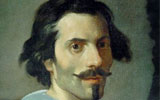
Bernini Gian Lorenzo
At the age of just eight years, his father Pietro brings him to Rome from Naples , where he was born. As he himself confessed, the passionate study of the works of the Carraccis conributed more to his formation than his father's teaching; in them he found a summary of the best qualities of the great artists of the Renaissance, from Raphael to Michelangelo, and even more so in the close and adoring observation of the ancient statues collected in the Vatican gardens.The Carracci classicism, illuminating though it was, did not suffocate the young artist's utterly original and revolutionary inspiration. His first works ( head of Bishop Santoni, S. Sebastiano,S. Lorenzo ), executed between 1614 and 1616 presage all the novelty of Bernini's vision, in spite of their rough rendering. These works drew the attention of cardinal Scipione Borghese, who commissioned the four sculptural groups now in the Borghese Gallery, which the young sculptor carried out between 1616 and 1624. The group of Aeneas, Anchises and Ascanius, in spite of their pronounced verticality and animation suggested by the contrasting gestures of the three figures, still shows the influence of Pietro Bernini on his son, to the point that some modern scholars maintain that the work was the result of the collaboration between the two artists. In the other three, however, ( David , 1619, Rape of Persephone , 1620-21, Apollo and Daphne , 1621-22), the whole expressive model of all Baroque sculpture is put into play. In these works, the spiral movement favours the link between surroundings and figures, which are observable from a single viewpoint and therefore highly revolutionary with respect to Renaissance classicism. But an even greater novelty is the unsurpassed masterliness of the modelling, full of pictorial nuances, and in the intense psychological expression of the faces, taken to such an extreme as to risk illusionary realism. In the art of Bernini, therefore, are suddenly manifested the seventeenth-century passion for nature and sentiments, the need to sound the innermost secrets of the human soul, and, simultaneously and unequivocally, indulgence in the whims of a softly sensual fantasy. This exceptional psychological capacity explains the realistic concreteness and the penetration the busts sculpted by the master between 1620 and 1622 (Cardinal Montoya, Cardinal Roberto Bellarmino, Gregory XV ), a prelude of the highest class to the works of his maturity (busts of Costanza Buonarelli, 1632, Cardinal Scipione Borghese, 1632, Urban VIII, 1640 and Innocent X , 1648-50) and of his old age (portraits of Francesco 1 d'Este, 1651, and Luigi XIV, 1655). The last of these were conceived in the “grand manner” which marked every one of his works after 1650, and seem to rise as symbols of the seventeenth-century conception of sovereignty. We have already seen how Bernini, in the groups commissioned by cardinal Borghese had restored life and warmth to sculpture, infusing it with the chromatic and tonal values of painting. It was not for nothing, therefore, during the pontificate of Urban VIII (1623-44) and then occasionally up to 1655, that he was an active painter, executing about 150 works, of which most have been lost. Of the ten or so which survive, most are portraits ( Urban VIII , 1625), Self- portraits of the Uffizi (about 1640) and of the Borghese Gallery (1655), in which it is possible to see, in the greater skill in execution and psychological refinement, how the original influence of Van Dyck, who lived in Rome 1622-23, was being substituted with that of Vel ázquez, whom he had met in Rome in 1629. Furthermore, at the basis of Bernini's inspiration is the tendency, common to all the Baroque, to overcome in the course of creation every distinction between the three arts, which had been rigorously kept apart by Renaissance rationalism. Not for nothing did Bernini hone his fantasy daily with intense activity as scenographer and organizer of theatrical spectacles, for which he sometimes provided the text, as is confirmed by the discovery of one of his comedies. This taste for the picturesque and scenographic, this fusion between architectural elements and plastic values, dominate in the Baldacchino fo St Peter's; it is a work both of architecture and of sculpture, erected in nine years (1624-33) to fill the great empty space at the crossing of the naves of Bramante under Michelangelo's immensely lofty cupola. In it the classical motif of the twisted columns is renewed with an impetuous upward motion to the sumptuous crowning of bronze, which swarms with angels. The baldacchino, a real manifestation of Baroque architecture, is a clean departure from formal sobriety of the works with which Bernini hd begun his career as architect in 1625 (the rebuilding of S. Bibiana, the restoration of the Palazzo di Propaganda Fide, the remaking of the fountain of the Barcaccia). He undertook the continuation of the building of Palazzo Barberini, begun by Maderno; Bernini was responsible for the bold invention of the front with the great embrasured windows, the Fountain of the Bees and that of the Triton, both of which were built near the palace. In these Bernini's search for imposing mobile forms on rhythms of curved lines is further refined. There are two other works from the period of the pontificate of Urban VIII, who was very attached to Bernini, - the statue of St Longinus (1629-38) and the sepulchral monument to the pope, begun in 1642. In the St Longinus , which is highly Baroque in its unity, with its appearance rendered more potent by the foreshortening of the open arms, Bernini gave concrete form to his ideal of a shape freely expanded into space; the tomb, solemn, magnificent and intensely pictorial in the movement of the plastic masses, was the very model of baroque funeral monuments on account of its grandly allegorical character. But the first phase of the of the life and activity of Bernini was now finished; when Innocent X Pamphilj succeeded to Urban VIII in 1644, Bernini fell into disfavour and Borromini was preferred to him. Confined to private life, the master then created the allegory of Truth discovered by Time, of which only the figure of Truth was sculpted; this was an enormous female nude, so exuberant and shapely as remind us of the sensual vitality of the women painted by Rubens. There followed the Ecstasy of S. Teresa (destined for the Cappella Cornaro, an astounding composto (Bernini's word) of the three arts realized by Bernini in the church of S. Maria della Vittoria (1644-51). The group is perhaps the artist's most intensely poetical; the image of the saint, portrayed at the zenith of mystical ecstasy, while an angel shoots an arrow towards her, is all enwrapped in a warm and voluptuous luminosity which sublimates the natural sensuality of Bernini's fantasy in the lyrical intuition of an unrepeatable religious experience. Immediately afterwards, the fortunes of Bernini took a turn for the better again, with the Fountain of the Four Rivers in Piazza Navona (1647-51), perhaps the highest point reached by Baroque art, in fusing the plastic and landscape element and for the picturesque linking of the slender shaft of the obelisk with lively sculptures and the sonorous beating of the water. In the meanwhile, Innocent X commissioned the artist to decorate the side aisles of St Peter's and the princes Ludovisi asked him to construct the Palazzo di Montecitorio. The master only completed the lower part of the façade, however, and the rest of the building was completed by Carlo Fontana. Under the pontificate of Alexander VII Chigi (1655-67), Bernini directed the restoration of the Porta del Popolo and then turned to his most famous work, the colonnade of St Peter's. At the moment of planning this extraordinary example of architecture open to the broadest effects of light and atmosphere, the master set out to correct the defects in the proportions in Maderno's façade, which was too wide and flat, and to restore all the magnificence deriving from Michelangelo's vision of the cupola. In order to achieve this, he enclosed the broad piazza with two elliptical wings of Doric columns, arranged in four rows and linked to the façade with a trapezoidal space, in such a way that the architectural masses, and the immense space delimited by them, seem to open up dynamically as one advances towards the basilica. Another problem, that of decorating the inside of the apse, was caused by the longitudinal structure of the basilica as result of the works carried out by Bramante. Bernini resolved this too, by erecting the Triumph of the Chair of St Peter, an enormous creation of gilt bronze ordered by Alexander VII to symbolize with unusual magnificence the universality and unity of the Catholic Church. These were years, then, of frantic and multiform activity, in which Bernini was engaged in multiple works of sculpture and architecture. The statues for the Chigi Chapel in S. Maria del Popolo were sculpted and the Maddalena and the S. Girolamo in the cathedral of Siena, at the same time as the artist was doing all the following: erecting the church of S. Andrea al Quirinale (1658), elliptical in plan and widening to either side of the entrance in accordance with a scheme developed by Borromini, putting up the church at Castel Gandolfo, Greek cross in shape, and building the Scala Regia (1664-66), where the limits imposed by the smallness of the space persuaded Bernini to use of illusionary perspective artifices. In 1655, at the height of his fortunes, Bernini was invited by Louis XIV to prepare a project for the façade of the Louvre, and therefore in 1665 he went to Paris . None of the three projects he prepared was accepted, however, perhaps because his conception contradicted the severe classicism of French architecture. Bernini was able to make for Louis XIV, however, both the bust already referred to and a great equestrian monument, which today, slightly altered, is at Versailles . After five months the artist returned to Rome, embittered by the rejection he had suffered, but ready to take up again his multiple work.To this last phase of the life of Bernini belong the church of the Collegiata at Ariccia, the equestrian statue of Constantine, conceived with a theatrical overstatement but not without a certain magnificent dignity, and the bust of Gabriele Fonseca, a pitiless image of an old man already sick with senility. In other cases the old artist limited himself to the preparation of the plans, leaving the job of realizing the work to his helpers. This was the case of the Elephant holding the obelisk in Piazza della Minerva , of the decoration of the Ponte S. Angelo , ordered by pope Clement IX and partly by Bernini himself, and for the monument of Alexander VII in St Peter's, a baroque elaboration of the tomb of Urban VIII. In 1673, Bernini's wife, Costanza, died, at a time he was engaged on the transformationof the apsidal tribune of S. Maria Maggiore, then finished by Carlo Rainaldi. Two years later, the image of the Beata Ludovica Albertoni, portrayed at the moment of passing away, while, with her throat uncovered and gently palpitating, she lifts her waxen face towards the light, brought to an end the long period of activity of the master with a fearful and religious contemplation of death. Bernini died in Rome in 1680.