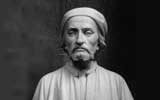
Italian architect and painter ( Siena 1490 - Rome 1536). He was formed in Siena , where he was influenced by Pinturicchio in painting and by Francesco di Giorgio in architecture; a little over twenty, he went to Rome to deepen there his preparation as an architect carrying out studies and researches on classical antiquity. When, in 1510 he obtained from Agostino Chigi the commission to erect the Farnesina (in front of the Galleria Nazionale di Palazzo Corsini, in via della Lungara - Iter 5 ) he thought of building and decorating it keeping in mind Ovidio's description of the Sun's royal court in his Metamorphosis . The architectonic structure of the beautiful building, with its harmonic purity of lines still in a fifteenth century spirit, keeps to the Francesco di Giorgio's style; the pictorial decoration instead allows us to follow the painter's evolution: while the ground floor's friezes, although demonstrating the study of ancient encaustics, refer to Pinturicchio, the frescoes of the upper hall, even though they remind of the examples of Raffaello's Galatea and the Stanza della Segnatura, with their research of perspective illusionism already bear a mannerist imprint. Memories of Raffaello and of the antiquity are present also in the Presentazione al Tempio in the church of S. Maria della Pace, but when Sodoma came to Rome (around 1515), it was this maestro to suggest to Peruzzi the modes for the frescoes of the Ponzetti Chapel in the church of S. Maria della Pace (iter 6) that are his pictorial masterpiece. In 1527 Peruzzi went away from Rome; after working in Emilia (project for the façade of S. Petronio in Bologna; arrangement of the inside of S. Niccolò in Capri) and in Siena (project for the Nuovo Duomo; Palazzo Pollini; Villa Belcaro; fresco with Augusto e la Sibilla in the church in Fontegiusta), he returned (1532) to Rome and here created another masterpiece in Palazzo Massimo alle colonne ( iter 5 ), originally resolved in the slightly convex prospect that spreads to frame the shadowy profoundness of a courtyard with architraves. It's this very search for shadow and light effects that reveals in Peruzzi the first, and great, mannerist architect. His son Giovanni Salustio or Salvestro (born maybe in Siena – died in Vienna 1567), also an architect that worked in Rome (façade of the church of S. Maria in Traspontina) and in Vienna .