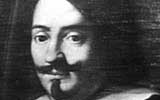
Formed in his native Bologna in Ludovico Carracci's Academy, then in Mantova he studied Giulio Romano's frescoes in Palazzo del Tè and restored ancient statues kept in the Galleria dei Gonzaga in that city, when he came to Rome in 1625 he had already elaborated a complex experience that would make congenial to him the classicizing taste so common in many artists who had at that time immigrated to the City, as the Flemish sculptor Francesco Duquesnoy and the French painter Nicola Poussin. This classicism, so far from Bernini's tumultuous chiaroscuro taste, is easily perceived in Algardi 's first roman Works: il S. Giovanni e la Maddalena in S. Silvestro al Quirinale, the portraits for the Frangipane sepulchers in S. Marcello (iter 7), cardinal Mellini' s bust in S. Maria del Popolo' s aristocratic chapel (iter 7) . Elected in 1640 as prince of the Accademia di S. Luca, he headed towards greater fortune, when he had already sculpted his first large group, that is the S. Filippo Neri e l'Angelo for S. Maria in Vallicella's sacristy , which was followed by a bronze bust of Gregorio XV and the group with the Decollazione di S. Paolo for the church of S. Paolo in Bologna. Once Innocenzo X (1644) was raised to the papal seat and Bernini fell in disgrace, Algardi 's way was open to the more important and ambitioned commissions, finding affirmation also as an architect; in fact the building of Villa Pamphili on the Janiculum belongs to these years, in this Algardi drew from the sixteenth century Villa Medici however accentuating the vertical development of the factory and covering the four façades of an ornamentation more stale than sumptuous, derived from that performed by Giacomo della Porta for the Gesù and S. Ignazio's façade , traditionally ascribed to Algardi, while the rest of the church was built by the Jesuit Orazio Grassi, that made use of drawings by Domenichino. Of far greater significance are the sculpted works, in which Algardi's Style is enriched of new dramatic effects, of a more vibrant modeling, of a more balanced sense of movement, yet complex and open: such are the bronze statue of Innocenzo X in Palazzo dei Conservatori ( iter 1 ), the great bas-relief altar-piece l'Incontro di papa Leone Magno ed Attila in S. Pietro and the funeral monument to Leone XI in the same Vatican Basilica ( iter 9 ); a series of wonderful portraits also belongs to this period, among which the woman's bust Olimpia Pamphili stands out on account of its incisive and sharp effect.